Music And Sleep
How Soothing Melodies Can Improve Your Rest

The Study: Can Music Deepen Rest?
Researchers from the Universities of Freiburg and Zurich monitored the sleep of 27 young women in two conditions:
A 90-minute nap with relaxing music.
A 90-minute nap in silence.
Results showed:
Better perceived sleep → participants felt more relaxed and rated their sleep as deeper with music.
Brain activity changes → music reduced light sleep (Stage N1) and increased slow-wave sleep (SWS), the most restorative sleep stage.
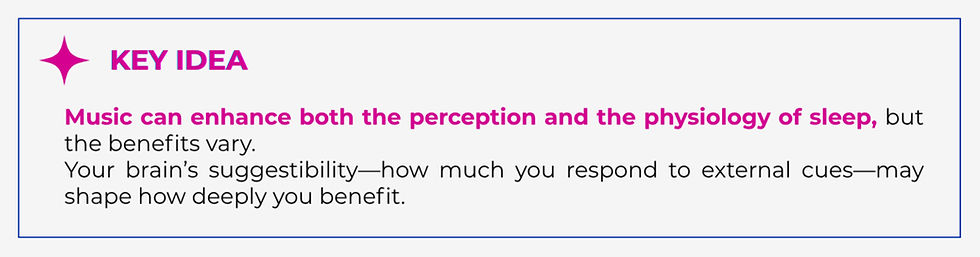
Suggestibility effect → people with low suggestibility benefited most, while highly suggestible individuals did not show the same gains.

How Music Helps the Brain Sleep
Neuroscience offers several explanations:
Reduces stress hormones → lowers cortisol and heart rate.
Synchronizes brain waves → slow rhythms (60–80 BPM) match natural sleep oscillations.
Masks environmental noise → helps block out traffic, voices, or disruptions.

Why It Matters
Understanding how music interacts with sleep has wide-reaching importance:
Sleep health: Non-pharmacological methods like music provide natural tools for insomnia.
Clinical impact: Could support patients with sleep disorders, depression, or anxiety.
Everyday well-being: Shows how simple routines (like a sleep playlist) can boost cognitive recovery.
Personalization: Not all music works the same for everyone—tailoring rhythms and styles may maximize benefits.
Conclusion: Music As Natural Sleep Medicine
This study confirms what many of us have felt intuitively: music can soothe the mind, deepen sleep, and promote well-being—without medication.
But it also highlights the importance of individuality: some brains respond more strongly than others. The key is curiosity—experiment with rhythms, genres, and tempos until you find your melodic match.
Next time you struggle to sleep, skip the sheep,
and press play instead.
Your brain just might thank you.
Source: “Music enhances deep sleep in low suggestible participants,” Scientific Reports (2025)


Comments