Why Does the Brain Get Distracted So Easily?
A Mind That Slips Away

A Mind That Slips Away
It happens so easily. You sit down to focus, and within minutes your mind is somewhere else. A sound in the background, a phone notification, a passing thought, a memory, a worry, and attention slips away almost automatically. But distraction is not simply a failure of discipline. It reflects something much deeper about how cognition works.
The brain was never designed to ignore everything except one task. Instead, it evolved to balance two competing needs: staying focused on a goal while remaining sensitive to anything new, unexpected, or potentially important in the environment. In that sense, distraction is not a flaw in the system. It is part of the system itself.
The Limits of Attention
One major reason distraction happens is that attention is limited. Cognitive resources are not infinite, so the brain cannot process every stimulus with equal depth. This means attention must constantly select what matters and suppress what does not.
When a task is demanding, that filtering system can become strained. When a task is repetitive, attention may begin to drift. In both cases, the brain is continuously managing competition between relevant and irrelevant information.
Why Salient Stimuli Win
Another key factor is salience. Some stimuli naturally stand out: a sudden sound, a bright object, a face, a movement, or anything unexpected. These signals do not quietly wait for permission to enter awareness. They push for it.
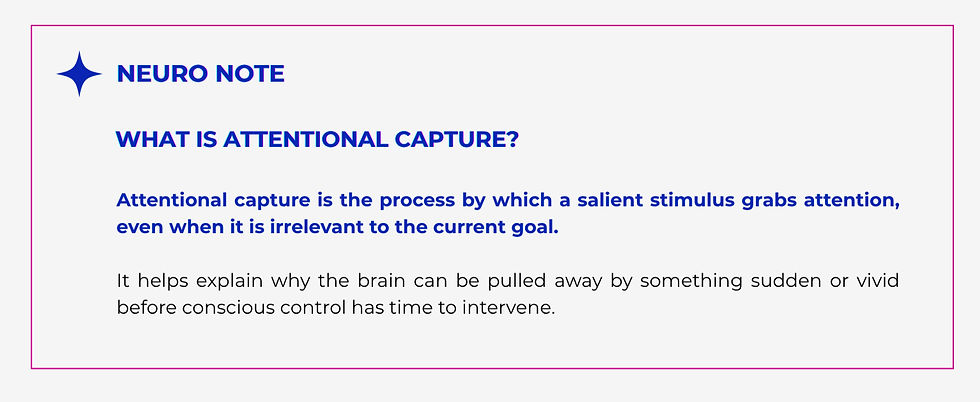
Researchers call this attentional capture, when something irrelevant pulls attention away simply because it is noticeable enough to do so. That is why even completely irrelevant distractors can interrupt thought. The brain is built to check signals that might matter, even when they later turn out not to.
When the Distractor Comes from Within
Distraction is not caused only by the outside world. Sometimes the strongest distractor is internal. A memory, a plan, a fantasy, a worry, or a completely unrelated stream of thought can appear while reading, studying, or listening.
This is often linked to mind-wandering, when attention shifts away from the external task toward internally generated thoughts. Research suggests that this kind of internal distraction is associated with brain systems involved in self-generated mental activity, including parts of the default mode network. When task focus weakens, internal content can compete more successfully for attention.
Filtering the World, and the Self
This helps explain why distraction can happen even in a silent room. The brain is not only filtering the world around us; it is also filtering itself. Some studies suggest that people with stronger working memory capacity are better at resisting internal distraction, possibly because they can suppress irrelevant mental activity more effectively and keep task goals active.
Focus, then, depends not only on what happens around us, but also on how well the brain regulates its own ongoing mental noise.
A Distractible Brain Is Also an Adaptive Brain
Interestingly, distraction is not always a sign that attention has failed. In some cases, it reflects the brain’s adaptive priorities. Unexpected sounds, novel events, and emotionally meaningful stimuli can interrupt concentration because, in evolutionary terms, ignoring them completely could be costly.
Even auditory distraction seems to arise not simply from weakness, but from the brain’s sensitivity to change in structured sensory input. In that sense, a distractible brain is also a responsive brain.
The Brain Can Fight Back
At the same time, the brain is not helpless. Research on distractor suppression shows that attention can prepare in advance to reduce the impact of irrelevant stimuli. Expectations, prior knowledge, and learned patterns all help the brain filter more effectively.
Suppression does not always work perfectly, but distraction is not purely automatic either. Focus emerges from an ongoing tug-of-war between bottom-up signals that demand attention and top-down control systems that try to keep cognition on track.

Working Memory Under Pressure
There is also an important link between distraction and working memory: the mental workspace that temporarily holds and manipulates information. When working memory is overloaded, it becomes harder to protect relevant information from intrusion.
That is one reason multitasking often feels so inefficient. The brain is not truly performing several demanding tasks at once; instead, it is rapidly switching and repeatedly paying the cost of interference. Distraction is not only about losing focus for a moment. It is also about how difficult it becomes to rebuild the cognitive state needed for the original task.
Why Distraction Belongs to Cognition
So why does the brain get distracted so easily? Because cognition is built around selection, competition, and flexibility. The brain must focus, but it must also stay open to change. It must protect goals, but it must also remain alert to novelty. It must hold a thought in mind while resisting interruptions from both the external world and its own internal activity.
Distraction, then, does not mean the brain is poorly designed. It means the brain is trying to do many important things at once.
Why It Matters
Understanding distraction changes the way we think about focus. It suggests that losing attention is not simply laziness or lack of motivation, but a cognitive phenomenon shaped by limited resources, salience, internal thought, and control mechanisms.
This matters in education, mental health, digital environments, and everyday life. Improving focus may depend less on “trying harder” and more on creating conditions that reduce unnecessary competition for attention.

Conclusions
Distraction reveals as much about the brain as focus does, perhaps even more. A mind that gets pulled away easily is not necessarily weak or undisciplined; it is a mind constantly balancing attention, flexibility, and survival.
What looks like distraction is often the brain doing exactly its job:
negotiating a world that never stops competing for its attention.
Source:
The Distracted Mind; Adam Gazzaley & Larry Rosen.


Comments