Music Therapy And Dementia
A Bridge Between Emotions and Care

The Power Of Music On The Brain
Music profoundly affects brain regions tied to emotion, memory, and language. Neuroscience shows that music can:
Activate the limbic system, awakening emotions and autobiographical memory.
Stimulate the prefrontal cortex, improving focus and emotional regulation.
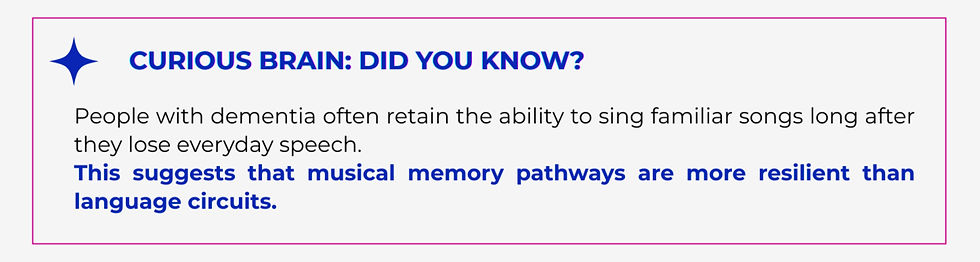
Reach intact neural circuits even in advanced dementia, rekindling positive memories and feelings.
This makes music uniquely suited to complement clinical care.

How Music Therapy Works In Dementia Care
Researchers identified three levels of action:
Individual Level – Emotions and Memory
Music evokes personal memories, reduces anxiety, and soothes agitation.
➡ Effect: Patients show calmer behavior and greater emotional balance.
Interpersonal Level – Communication and Relationships
Music becomes a shared language, bridging patients, caregivers, and families.
➡ Effect: Stronger emotional bonds, reduced loneliness.
Institutional Level – Integrating Music into Care
Care homes can embed music into routines, reducing reliance on sedatives and improving overall atmosphere.
➡ Effect: Less medication, better well-being, and a more positive environment.
Key Findings From Research
Music therapy leads to measurable benefits:
🎵 Reduced agitation and aggression.
🎵 Better communication with caregivers.
🎵 Lower stress and anxiety.
🎵 Improved quality of life with more positive moments.
Personalization is crucial: patients benefit most when music therapy aligns with their musical preferences and actively involves caregivers and families.

Why It Matters
The WHO and NICE increasingly recommend non-pharmacological interventions for dementia. Music therapy stands out because it is:
✔ Effective and evidence-based.
✔ Inexpensive and side-effect-free.
✔ Scalable across institutions.
✔ Able to restore dignity and humanity to care.
It shows that care doesn’t always have to come from a pill—it can come from a melody.
Conclusion: A Revolution In Dementia Care
Investing in music therapy could revolutionize dementia care, turning isolation into connection, and suffering into shared moments of well-being:
✔ It reduces distress without drugs.
✔ Strengthens emotional connections.
✔ Improves daily quality of life.
✔ Empowers caregivers with a new way to reach patients.
Music therapy demonstrates how art and neuroscience can merge
into a powerful therapeutic tool.
Source: Nature Mental Health (2025), Music therapy and dementia care


Comments