A Conversation With Ottavia Spreafico, Neuroscientist and Psychiatric Rehabilitation Specialist
When Music Becomes a Tool of Care
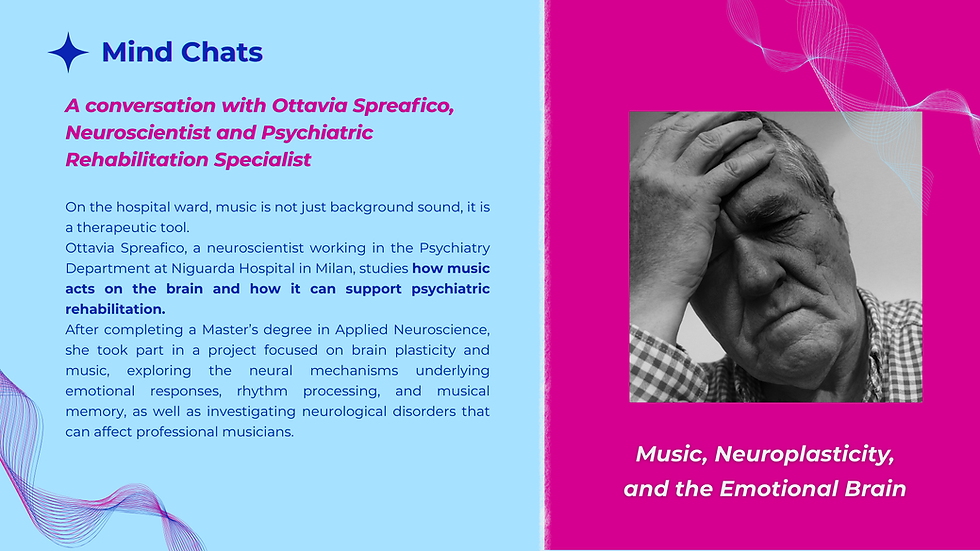
1. Ottavia, let’s start with your journey.
What led you to study Applied Neuroscience, and how did you become interested in neuroplasticity?
Ottavia: I decided to become a Psychiatric Rehabilitation Technician because I have always felt the need to work in close contact with people. I chose this specific training path because I believe that when someone experiences psychological suffering or a mental disorder, a deep rupture often occurs in their life story.

To truly heal that rupture, pharmacological treatment, although fundamental, is not enough on its own. It needs to be accompanied by a gentle form of care, made of rehabilitation, relationship, and support in regaining skills and a sense of continuity with one’s personal history.
After several years of working in rehabilitation, I felt the need to deepen my understanding of the cerebral mechanisms underlying change.

This led me to Applied Neuroscience, with the aim of increasingly integrating psychiatric rehabilitation with interventions grounded in neuroscientific knowledge and the principles of neuroplasticity.
Understanding how the brain can change over time has become essential to making interventions more conscious and effective, and to sustaining motivation and inspiration in my daily work.
2. Your academic path brings together science and music. During your Master’s degree, you explored the neural mechanisms activated by music.
What do you find most fascinating about the interaction between sound, emotion, and neural circuits?
Ottavia: My interest in neuroscience stemmed from a desire to understand why certain rehabilitative interventions work, particularly in emotional regulation. Music proved to be especially fascinating because it can act directly on neurophysiological mechanisms underlying emotional experience, often before conscious cognitive processing.
During my studies, I focused on how sound and specific rhythmic or frequency patterns activate ancient neural circuits involved in safety perception and arousal modulation.
You also took part in a project on brain plasticity and music. Could you tell us about it and what reflections it left you with?
Ottavia: The project focused on analyzing neural mechanisms activated by music, particularly the relationship between sound, emotion, and brain activity. I explored how specific musical features, such as repetitive rhythms, low frequencies, and simple structures, can promote calm and containment by acting on neural networks involved in emotional regulation and stress.

Through scientific literature, especially EEG and neuroimaging studies, I observed how music listening can alter brainwave activity, increasing alpha and theta waves, which are associated with relaxation, introspection, and emotional regulation.
A key concept that emerged was neural entrainment, the brain’s ability to synchronize with external rhythmic stimuli, using rhythm as a temporal organizer of mental states.
The most important insight from this experience was that music does not function merely as an aesthetic or cognitive stimulus, but as a deeply bodily and pre-verbal experience. Archaic sounds and steady rhythms seem to have privileged access to emotional systems, likely because they evoke early developmental modes of regulation.
3. Brain plasticity is a central theme in modern neuroscience.
How does music stimulate neuroplasticity, and how can it be used therapeutically or in rehabilitation?
Ottavia: Music stimulates neuroplasticity because it simultaneously engages multiple brain systems: sensory, motor, emotional, cognitive, and mnemonic. Listening to, and even more so producing, music activates distributed networks involving the auditory cortex, motor and premotor areas, the limbic system, and thalamo-cortical connections.
This integrated activation supports the formation and strengthening of new synaptic connections, especially when exposure occurs during sensitive developmental periods.

Numerous studies show that musical training in childhood, particularly between ages 6 and 8, coincides with sensitive phases of brain development. Research by Penhune and colleagues has shown that individuals who began playing an instrument before age 8 display structural differences in areas related to motor coordination, interhemispheric integration, and temporal processing, such as the corpus callosum and motor regions.
Longitudinal studies have also demonstrated that even a few months of musical training during childhood can produce measurable structural brain changes, confirming music’s direct role in neuroplastic processes.

From a therapeutic and rehabilitative perspective, music can serve as a non-invasive tool to facilitate change, especially in contexts where verbal access to emotions is limited or complex. Acting at a pre-verbal and bodily level, sound can reduce nervous system hyperactivation, promote a sense of safety, and create the neurophysiological conditions necessary for learning and functional reorganization.
In rehabilitation, this allows music to support emotional regulation, relational skills, and the reactivation of cognitive and attentional functions. Rather than a mere complement, music becomes a therapeutic mediator, capable of enhancing traditional interventions and supporting meaningful, lasting change.
4. You work in the Psychiatry Department at Niguarda Hospital.
What does your current role involve, and what kind of patients do you work with?
Ottavia: In the ward, I conduct rehabilitative and psychoeducational activities, often in group settings.
The aim is to help patients understand what led to hospitalization, recognize early warning signs of crisis, address stigma, and co-create a sustainable discharge plan.

We also offer socializing and calming activities with an occupational focus, which help ease the ward environment and create moments of normality, such as expressive activities or pet therapy. A crucial part of my role is providing relational support during moments of intense emotional distress, which can arise suddenly during hospitalization.

In the outpatient setting, I work on individualized rehabilitation paths based on shared goals: psychoeducation, coping skills training, functional time organization, cognitive rehabilitation, and support in regaining autonomy.
The patient population is very heterogeneous, but we frequently encounter personality disorders, depressive disorders, and conditions complicated by substance use or abuse.
5. Music can play an important role in psychiatric rehabilitation.
What types of activities or workshops do you offer to foster emotional expression and reconnection?
Ottavia: In the ward, we have experimented with music listening groups, mainly as tools for relaxation and emotional regulation. In acute settings, the goal is not intense expression, but rather calm and containment.

Art therapy workshops are also very effective, providing a non-verbal channel for emotional flow that respects individual timing and capacity.
We also use structured relaxation techniques, such as progressive muscle relaxation, and place strong emphasis on presence and relational support when intense emotions arise, given the sensitivity of the environment.
6. You have studied emotional responses related to rhythm recognition and musical memory.
What happens in the brain when someone hears a familiar melody or feels moved by a piece of music?
Ottavia: When a person hears a familiar melody, neural circuits related to memory, emotion, and reward are activated simultaneously. Familiar music evokes autobiographical memories, involving the hippocampus and limbic areas, while the dopaminergic system contributes to feelings of pleasure and emotional intensity.
Rhythm and melody also promote synchronization of neural activity, neural entrainment, facilitating states of emotional connection and bodily engagement. This is why music can evoke powerful emotions even without words: it operates at a deeply rooted, pre-verbal level of experience.
7. An intriguing aspect of your work involves neurological disorders in professional musicians.
Which conditions are most common, and how do they affect musicians’ careers?
Ottavia: During my Master’s degree, I focused particularly on musician’s focal dystonia, a neurological disorder affecting pianists, guitarists, violinists, and trumpet players. It manifests as a loss of fine motor control, where fingers or muscles involved in musical performance no longer respond as intended.

This condition can have a devastating impact on both career and identity, as it often prevents musicians from playing as they once did. Currently, one of the few specialized rehabilitation centers for this condition is located in Spain, using highly specific motor and sensory retraining approaches.
8. Working in psychiatry often means balancing science and humanity.
How does music help you maintain this balance, personally and professionally?
Ottavia: For me, music represents a space where technical knowledge and emotional experience integrate. Professionally, it reminds me that change does not happen only through protocols and structured interventions, but also through rhythm, presence, and relationship.
Personally, music is a tool for emotional regulation and replenishment, helping me maintain balance in an intense working environment.
9. Looking ahead, what do you see as the most promising directions in music neuroscience and cognitive-emotional rehabilitation?
Ottavia: I believe the most promising perspectives lie in deeper integration between neuroscience, clinical practice, and rehabilitation, with increasingly personalized interventions. Music neuroscience offers powerful tools for working on emotional regulation, memory, and attention, even in vulnerable populations.
In the future, I envision a more intentional and informed use of music as an integral part of therapeutic pathways, not just as a complementary activity.
10. Finally, if you had to describe music with one word that also captures its therapeutic power, what would it be, and why?
Ottavia: I would choose connection. Music connects mind and body, emotion and thought, past and present. Most importantly, it reconnects people with themselves and with others, creating a safe space where change can occur.

Conclusion
Ottavia Spreafico’s experience shows that music is not only art, but a form of biological dialogue between the brain and emotion. Every rhythm, every melody, and every silence can become a tool for reshaping connections, rebuilding identity, and restoring balance where the mind has fragmented.
In her work at Niguarda Hospital ...
science and sensitivity meet to give voice to the remembering brain — and to the heart that listens.


Comments